
Ceiling Drywall Repair & Replacement in Spring, TX | Spring Drywall Co.
Spring Drywall Co., a local drywall contractor, handles ceiling drywall repair & replacement for homeowners in Spring, TX. A ceiling gives you warning long before it comes down, whether that is cracked seams, board beginning to sag, fasteners that have worked loose and popped through the surface, or brown stains spreading from above. Each points to a different problem and calls for a different remedy, and we handle all of them, including taking a damaged ceiling down and hanging a new one.
A ceiling depends on its own fastening and support, so the details that keep it in place are set out in writing. We work to ASTM C840 and GA-216 for how gypsum board is hung and fastened, and to GA-214 for finish levels. Gypsum board is the mineral-cored panel used to build your ceiling. Any stained board is checked with a moisture meter, a probe that shows how wet the material is, and we do not close over it until the reading comes back dry. We have worked to those standards on Spring ceilings for 15 years, and we are insured.
We work throughout Spring and across north Harris and Montgomery counties. Popcorn texture removal, new ceiling hanging, wet ceiling repair and suspended tile work are each priced and handled as separate jobs. Your on-site estimate is free, with each part of the work listed in writing before you commit. Call (936) 286-6045 or use our quote form for a clear, written price on your project.
What Ceiling Drywall Repair & Replacement Covers
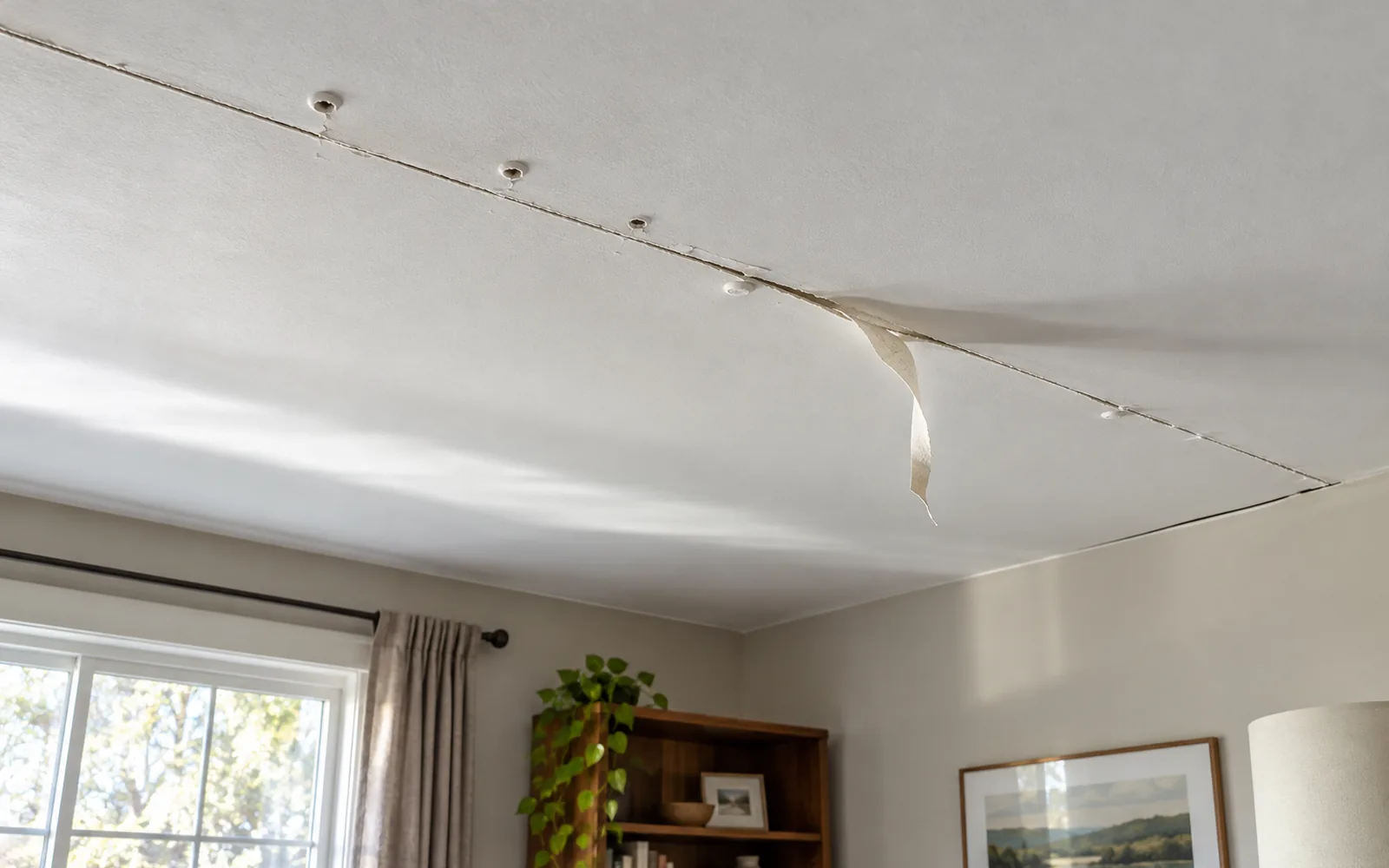
Ceiling drywall repair & replacement deals with a ceiling that is already in place and has started to fail, whether that is the board itself, the screws holding it, the paper tape over the seams, or the finish coat on the surface. Each part fails differently, so we sort ceiling damage by what has let go rather than by what caused it. Most ceiling jobs in Spring fall into one of five kinds of ceiling failure. What you see from the floor is not always the full extent of the damage, which is why we check the entire ceiling before opening anything up.
Sagging Board Between the Joists
A sagging ceiling dips in shallow curves between the framing that supports it instead of dropping evenly across the whole room, and it is usually easiest to see when daylight crosses the surface at a low angle.
Gypsum board bellies for three reasons: the screws have lost their grip and the panel is hanging from them, the board was wetted and dried without returning flat, or added weight above has pulled it down over time. We measure how far it has moved against the line of the framing above rather than judging it by eye, because a ceiling that looks only slightly out of line from below can already be beyond what the board is meant to support.
Seams That Keep Opening in the Same Line
A ceiling seam is the joint where two panels meet, with paper tape and compound covering it so the surface sits as one. When that joint splits, is filled and painted, then opens again within a year or two, the important detail is that the crack returns in the same place.
Ceiling crack repair that only replaces the tape leaves the same joint in place to fail again. A crack that is wide, stepped, or has one side sitting higher than the other needs to be evaluated by a structural engineer. We note that on the estimate instead of taping over it.
Fasteners Backing Out Overhead
Small round dimples, ridges, or raised heads appearing in a row across your ceiling are screws backing out of the framing. On a ceiling, that is different from the same problem on a wall because a screw that has lost its grip is also part of what holds the panel up.
Framing draws in moisture and releases it again with the seasons, moving slightly as it does. A screw driven hard enough to break the paper face had little grip from the start, and a panel fastened with a gap behind it lets go sooner than one pulled tight to the framing. Drywall ceiling repair here means securing the panel back into sound framing, then restoring the surface so it sits flat again.
Stained Board, and What the Stain Decides
A brown or yellow ring overhead shows where water has been, but it does not prove the area is still wet. Before we work on it, we confirm two things: that the source of the water has stopped and that the board and the space above it are dry now. We compare the exposed framing and surrounding materials against dry reference readings before closing the wall. Ceiling stain repair done before both are confirmed leaves the stain free to come back through the new paint. Finding the water source and drying a soaked assembly are separate from the ceiling repair itself.
When the Ceiling Comes Down Instead
A ceiling replacement means we take out the entire ceiling surface, or a defined section of it, instead of cutting into the existing board. Once the ceiling is open, we can inspect the framing above directly. Anything resting on top of the old ceiling, including blown-in insulation, has to be removed and put back after the new gypsum board is hung. Your estimate states exactly which area is included.
Repair or Replace: How We Read a Ceiling
Before we quote ceiling drywall repair & replacement, we inspect the ceiling as a whole rather than focusing only on the damaged area. Three things decide the scope: how far the damage extends, whether the ceiling was built within the published limits for gypsum board overhead, and whether the source of the damage has stopped. We settle that before giving you a price, because a patch that turns into a ceiling replacement halfway through the work is a different job with a different cost. Since the ceiling hangs as one continuous plane, we judge the repair against the whole surface, not just the hole.
When a Patch Is Still the Right Answer
Repair is the right choice when the damage has a clear stopping point. If the board around the failed area is firm and unstained, the framing above is straight and sound, and the leak or movement that caused the damage has been found and corrected, we restore the surface with a drywall ceiling repair and leave the rest of the room intact.
We cut the damaged area back to sound board and carry the cut to a joist so the new piece has solid framing to screw into. If the cut falls between joists, we fasten backing across the opening first so the patch has a firm edge to land on. That keeps more of the room untouched, and on a sound ceiling it is usually the cheaper option.
When the Plane Itself Has Gone
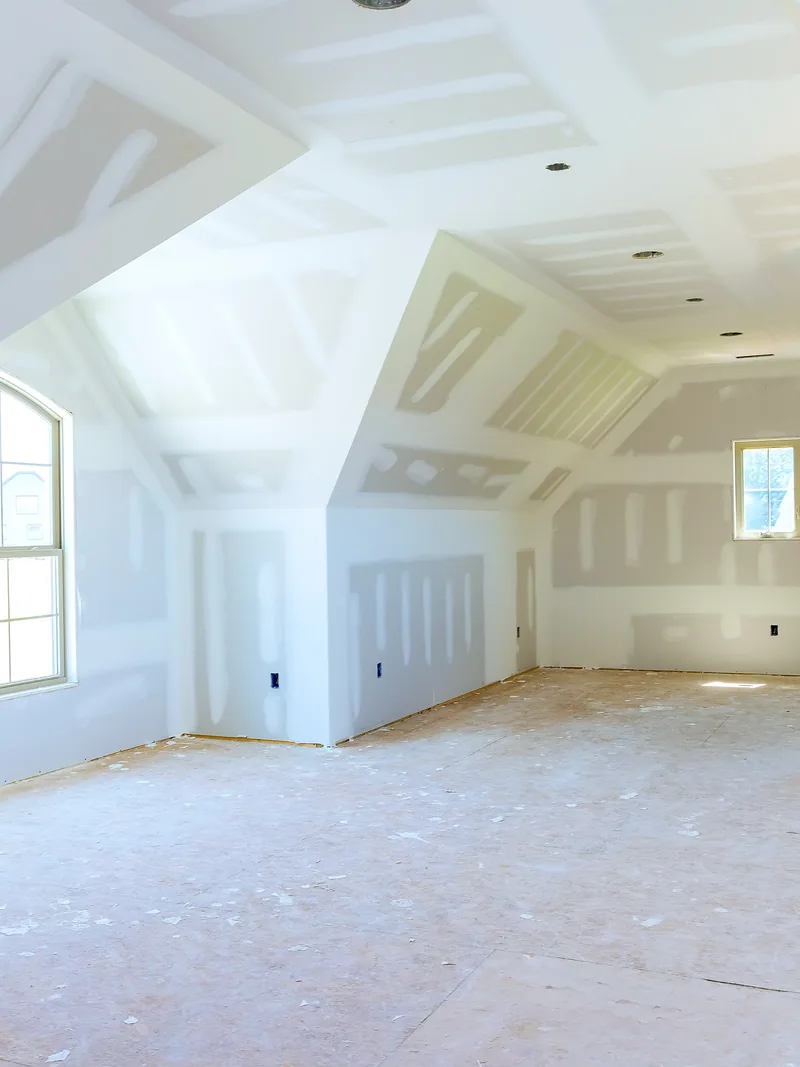
Replacement is the right answer when the problem affects the whole ceiling plane rather than one damaged area. Gypsum board follows the shape of the framing it is fastened to, so a ceiling can be undamaged and still look uneven because the framing behind it no longer sits flat. GA-216 allows only 1/8 inch of variation between neighboring supports, and framing that carries a ceiling is held to a deflection limit of L/240 of its span.
If a ceiling was built outside the spacing limits from the start, a patch leaves the same dip in place instead of correcting it, and the bow shows again under the next coat of paint. Once the damage extends across enough of the ceiling, ceiling drywall replacement gives you one continuous surface instead of a series of visible repairs.
The Garage Ceiling Is a Special Case
A garage ceiling with living space above it does more than an ordinary ceiling. The residential code treats it as a fire separation between the garage and the rooms overhead, and section R302.6 calls for 5/8 inch Type X board, a gypsum board made with additives that help it stay together longer in a fire. Using ordinary board for a patch removes that protection, and the finished surface gives you no way to tell the difference.
No board carries a rating by itself. The fire rating belongs to the full tested fire-rated assembly, including framing, fasteners, layers, and joints, so we treat rated work as a separate scope rather than something an ordinary repair can provide. Our job here is to recognize that condition before we cut into the ceiling and explain what we found.
Cost of Ceiling Drywall Repair & Replacement Work in Spring
The figures below show what ceiling work tends to cost across Spring based on the local market, not a price quoted for your job. General ceiling drywall repair runs from $400 to $1,300, while repair of a ceiling stained by attic condensate runs from $500 to $1,500 because wet board has to be removed before anything is put back. These figures are only a starting point for the conversation. The written estimate we give you after inspecting your ceiling is the only document that sets the price for your work.
What Moves the Price Overhead
A ceiling costs more than the same area of wall because of its position. Every cut, fastener and coat is done from a platform with the work above shoulder height, and each sheet of gypsum board has to be held flat against the joists while it is screwed into place, which requires a lift or a second pair of hands.
Matching the existing finish across the whole ceiling adds to the cost because a patch that does not blend in will still look like a repair from the doorway. Blown-in insulation above the ceiling has to be pulled back before we open it and put back afterward. On a stained ceiling costing close to $1,500, the price is driven by removing wet material and doing the work overhead, not by the size of the stain.
Where a Replacement Lands Against a Patch
A patch is priced on the area we cut out and restore, so most fall within the $400 to $1,300 range. Ceiling drywall replacement is priced on the full ceiling plane and includes work a patch does not, such as pulling back and reinstalling the insulation above and hauling away the old board. Replacement therefore costs more than a single patch in most cases, but on some ceilings it is still the less expensive way to finish the job properly.
If the same ceiling has been opened three or four times, the cost of those patches can add up to more than taking the whole ceiling down once. We sort that out during the estimate. Where repair and replacement are both practical options, your estimate can show the two scopes side by side. Call us at (936) 286-6045.
How a Ceiling Job Runs, Start to Finish
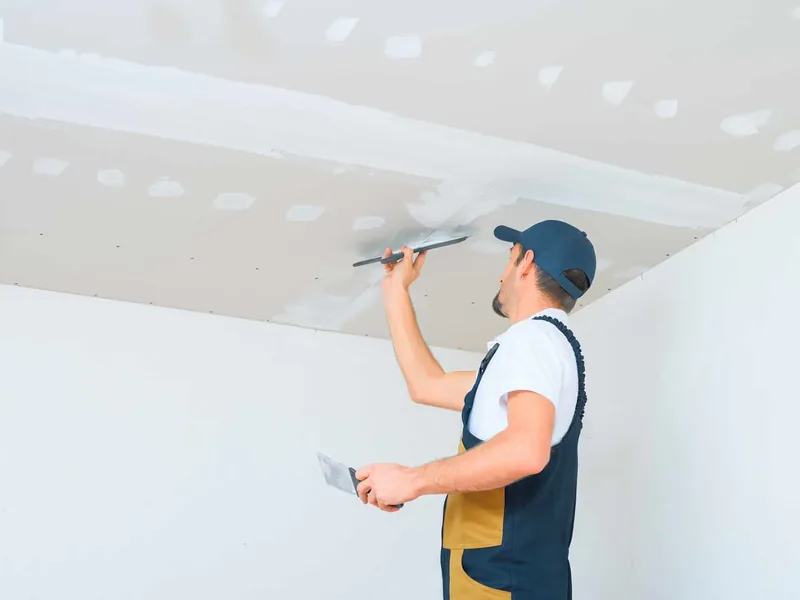
A ceiling job follows five steps, with nothing above your head opened until we have inspected the ceiling and put the price in writing. The first two steps are a conversation and an on-site visit, and by the end of that visit you know what work is needed and what it will cost. You decide whether to go ahead from there.
-
1
Tell us what the ceiling is doing
Tell us what changed and about when you first noticed it, because a mark that appeared last week points to something different from one that has been there for years. A photo taken from the floor helps us understand the problem before the visit. We will ask whether the ceiling is still moving or the damage is spreading, and whether anything above it, such as a bathroom, roof, or air handler, has leaked.
-
2
The on-site inspection
Spring Drywall Co. inspects the ceiling in the room itself. We sight across the surface to see where it has dropped, locate the framing the gypsum board is fastened to, and moisture-check any discolored area to find out whether it is still damp. We also identify what is above the board because that affects the scope of the work. The visit and the estimate are free.
-
3
The written scope and price
You receive a written estimate that explains whether the ceiling will be patched or replaced and why. You see the scope and price before you agree to the work.
-
4
The day the work happens
Clear what you can from the room below and cover anything that cannot be moved; we handle the rest. Plastic barriers, sealed doorways, and vacuum-assisted sanding are part of the base scope on every occupied-space job, not an add-on. Each coat of compound has to dry before the next one goes on, so ceiling work is rarely completed in a single visit.
-
5
The finish and the walk-through
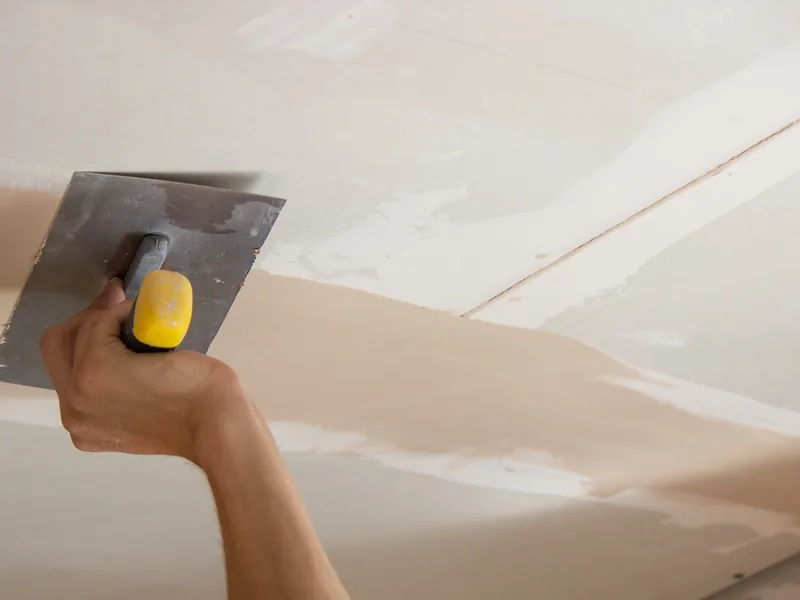
We match the repaired area to the texture around it and prime the surface, because bare compound and old paint reflect light differently and the match cannot be judged properly until the surface is uniform. We then walk the room with you under its own lighting so you can inspect the repair.
If your ceiling has started sagging, staining, or opening along a seam, call (936) 286-6045 or send a few details and a photo through the quote form. However the ceiling drywall repair is handled, we inspect it first and put the price in writing before anything is cut.
How a Ceiling Is Built to Stay Flat
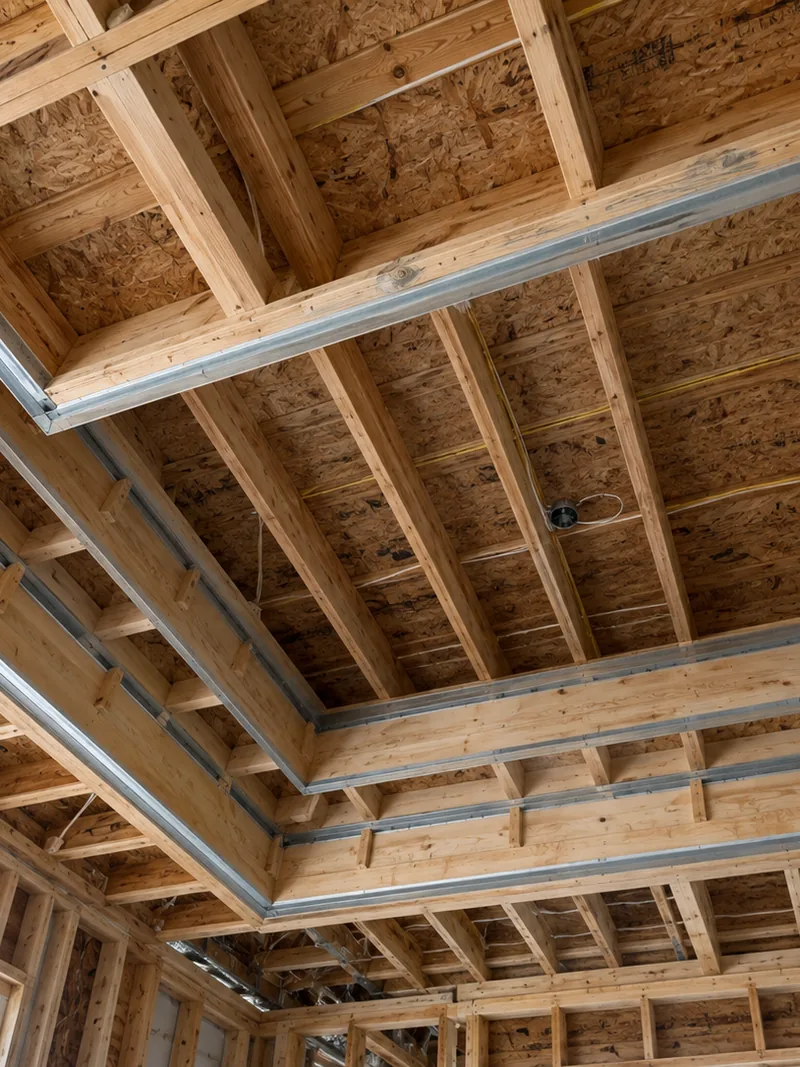
A ceiling holds its shape because of the support above it, not because of the last repair made to the surface. Before we price ceiling drywall repair on an existing ceiling, we check how far apart the ceiling joists are, how thick the board spanning them is, and what weight sits on top of it. If that combination falls outside the published limits, the ceiling will sag again after any patch no matter how well the surface is finished. Finding that out is the first part of the job.
Joist Spacing and the Board It Takes
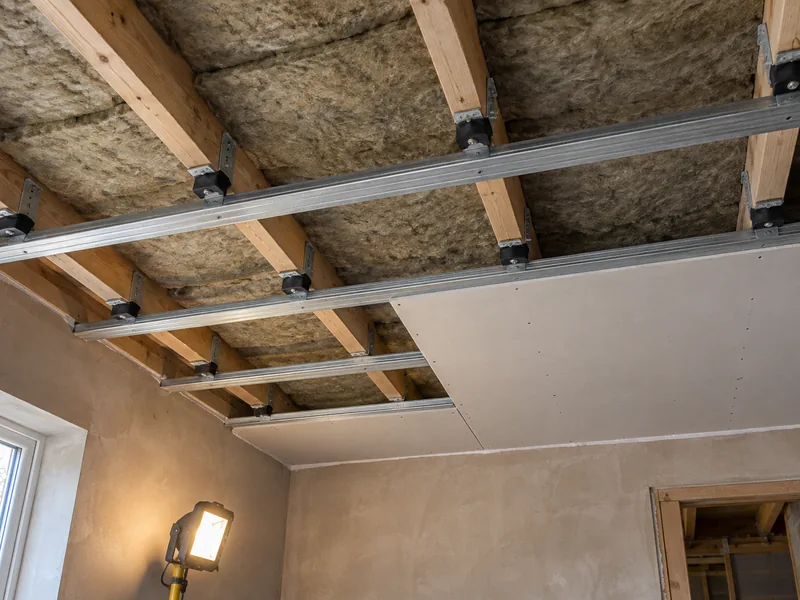
Ceiling joists are the framing the board overhead is screwed into, and the spacing between them determines how thick that board needs to be. GA-216, the Gypsum Association's published specification for applying gypsum board, allows half-inch board over joists spaced 16 inches apart when the sheets run with the framing. At 24-inch joist spacing, half-inch board is permitted only when the sheets run across the joists rather than along them, and that is a requirement, not a preference.
Where a sprayed water-based texture is applied over 24-inch framing, the specification gives two options: 5/8 inch board, or half-inch gypsum ceiling board, a sag-resistant panel made for this use, installed across the joists. If none of those requirements are met, the standard identifies ceiling sag as the result.
Why Overhead Fastening Is Its Own Skill
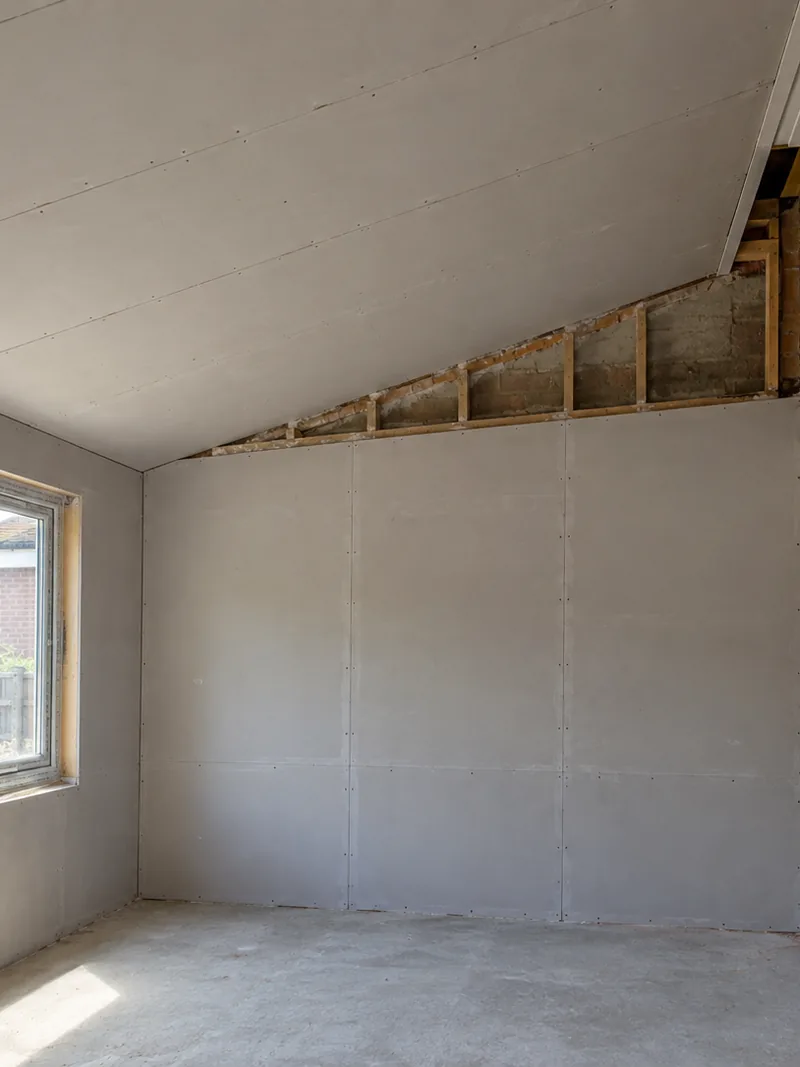
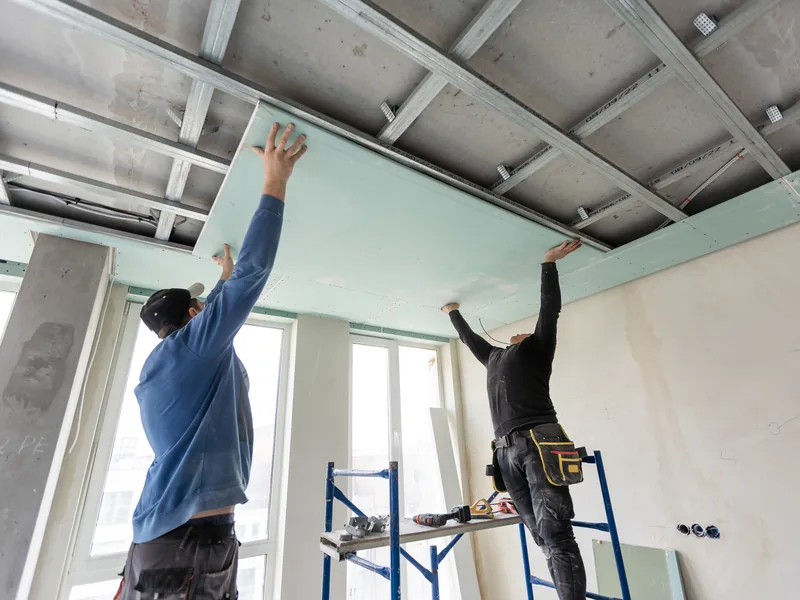
Gravity pulls against ceiling fasteners in a way it does not on a wall, so drywall ceiling repair depends on keeping the board tight to the framing while each screw goes in. The sheet has to be held firmly against the framing at the moment it is fastened, which is why we use a drywall lift instead of holding it up by hand and work outward from the middle of the sheet.
The standard does not allow fastening inward from both edges at once because that can trap a gap in the middle that later screws will not close. Each screw head is set just below the surface while leaving the face paper, the covering that gives the board its strength, unbroken. GA-216 calls for 1 1/8 inch screws with half-inch board and 1 1/4 inch screws with 5/8. Where a ceiling has already sagged, the old holes no longer hold properly, so each new screw is driven beside the old one into sound framing.
What Is Sitting on Top of Your Ceiling
In this market, attic insulation sits directly on the back of the ceiling board, so the ceiling carries weight you cannot see from the room below. GA-216 sets limits on how much insulation load a ceiling can support without anything beneath it. At 24-inch framing spacing, half-inch board is rated for 1.6 pounds per square foot of insulation, while 5/8 inch board and half-inch gypsum ceiling board are rated for 2.2. Adding more blown-in insulation adds more weight, and a ceiling already at its limit has no capacity for the extra load. Where the board carries insulation and also receives a water-based texture, half-inch board is not permitted by itself.
Why Spring Ceilings Open in the Same Places
A ceiling line that opens in the same place every year is rarely a problem with the ceiling itself. Much of the ground around Spring is deep, slow-draining Beaumont clay with a high shrink-swell potential, meaning it changes volume as its water content changes. That soil supports the concrete slab your house stands on, and the slab supports everything fixed above it. Because the soil wets and dries on an annual cycle, the movement follows the same pattern, and the crack returns with it. If you have had ceiling crack repair done once and the same seam has opened again, the cause is usually below the house.
What the Clay Does Across a Year
Expansive clay takes in water during the wet months and swells, then loses that water through a dry summer and shrinks. The soil around a house does not dry evenly because shade, roof runoff, paving and planting affect how much water each side holds.
The concrete slab moves with that uneven ground, the walls stand on the slab, and the ceiling framing is carried by those walls, so even a small difference in soil movement can show up overhead as a line in the finish. You can compare it with the time of year by noting when the line widens and when it closes; it will usually follow the wet and dry seasons rather than appear at random.
Repairing a Line That Is Going to Move Again
A seam in a building that is still moving has to be rebuilt rather than covered. We cut the failed paper tape out of the joint instead of coating over it, because a new layer over split tape will split again in the same place.
The joint is then re-taped with paper tape and a setting-type compound selected for a joint that carries movement. We also drive fresh drywall screws through the board on either side of the joint into the framing, so the taped seam is not the only thing keeping the two boards in line. On ground that shifts every year, this kind of ceiling drywall repair gives you years rather than a permanent fix, and we explain that when we quote the work, not afterward.
Getting the Ceiling Back to One Surface
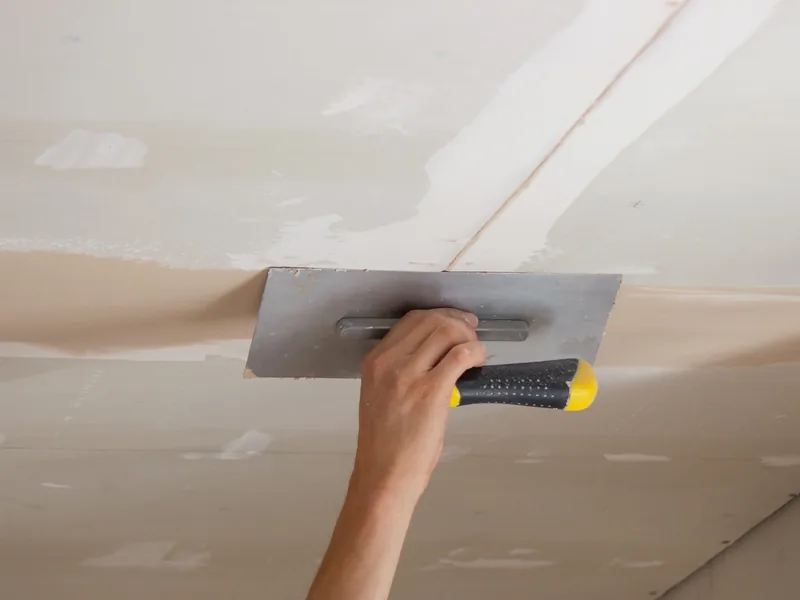
Once the damaged board is removed and the new board is in place, the remaining work is making the whole ceiling look like one surface rather than a visible patch. Two things decide whether the repair shows from the doorway: what goes over a stain before any coating is applied, and how closely the new ceiling texture matches what is already overhead. The texture match, along with the GA-214 finish levels that describe how smooth the surface is, belongs to our finishing and texturing work. For ceiling drywall repair, the issue we settle here is the primer.
Stain-Blocking Primer Before Anything Is Recoated
The brown or yellow discoloration left by a leak sits inside the gypsum board rather than on its surface, so an ordinary coating lets it bleed through and show again within weeks. A stain-blocking primer seals that discoloration in and keeps it from coming through the paint applied over it.
We apply it only after confirming the board is dry, and primer never replaces that check because covering a stain on wet board leaves the moisture in place. Primer also deals with the second reason a repair shows: fresh joint compound absorbs coating faster than the older board around it, which makes the patched area dry to a different shade. Priming gives both surfaces the same starting point so the ceiling takes color evenly across the repair.
Matching What Is Already Up There
A ceiling is harder to match than a wall because of the way light crosses it. Light from a window or fixture travels across the face of the ceiling at a shallow angle instead of straight on, which makes every ridge and hollow more visible. A repair that would blend into a wall still shows overhead, so you are left with two practical choices.
We can match the existing ceiling texture across the repaired area or refinish the whole ceiling so there is no transition to hide. Most Spring ceilings have either knockdown, a flattened spatter pattern, or orange peel, a finer stipple. Our finishing and texturing work covers ceiling texture matching, whole-plane retexturing, and popcorn removal in detail.
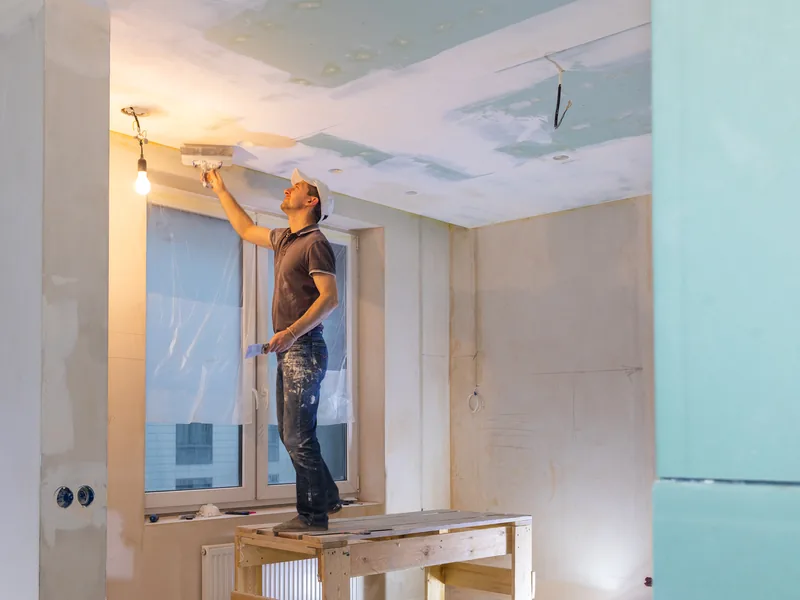
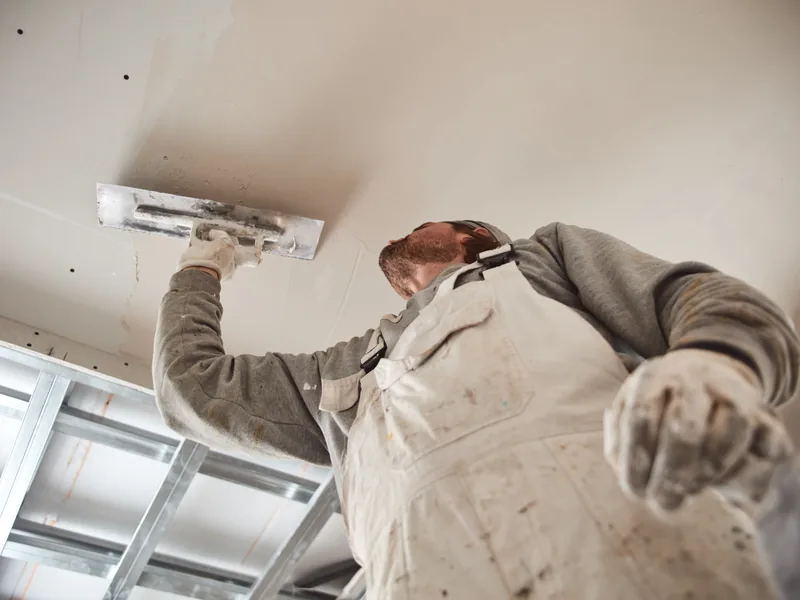
Where Ceiling Drywall Repair Stops and a Specialist Starts
Two conditions found in ceilings are regulated as separate trades in Texas: mold work beyond a small, contained area and material that may contain asbestos. We do not hold those credentials and do not perform either type of work. Our work is ceiling drywall repair, which means removing damaged gypsum board and replacing it with sound board. If either regulated condition is present, we tell you before the job starts because it changes who works overhead and the order the work has to follow.
Damp Ceilings and What Has to Come First
A ceiling opened after a leak sometimes reveals more than water-damaged board. When mold reaches past a small, contained area, Texas licenses that assessment and remediation work, so a licensed mold professional handles it first.
Our part of a water damage ceiling is the gypsum board itself: we remove the soaked panels, replace them, and check the framing and new board with a moisture meter before closing anything up, because board installed over damp framing will stain again. Where a ceiling sits below a bathroom or laundry, we can use moisture-resistant board, which is a material choice for damp air rather than a treatment for mold or moisture. We return to rebuild the ceiling after the specialist has finished.
Textured Ceilings and Testing Before Anything Is Disturbed
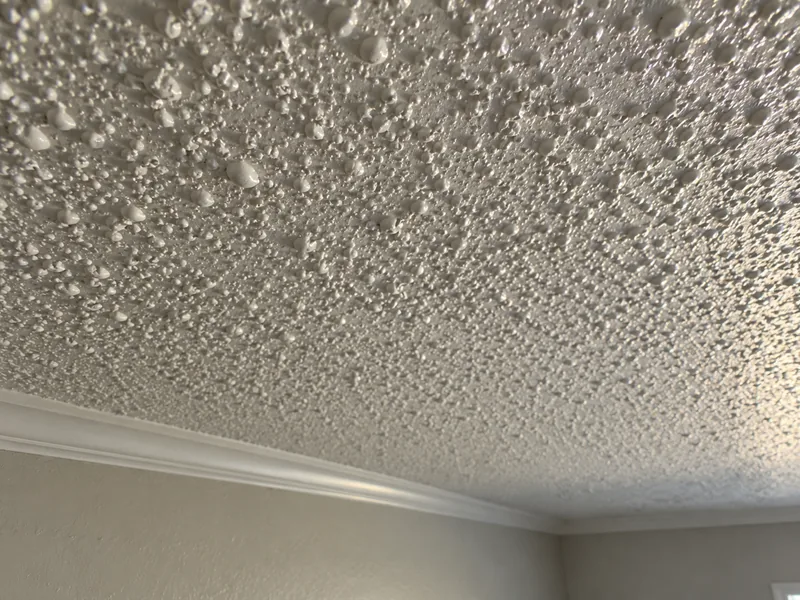
Many older ceilings have sprayed acoustic texture, a rough white coating applied wet and left untroweled, commonly called a popcorn ceiling. Repairing it requires disturbing the surface, which is where the second boundary applies. Popcorn texture or other suspect material is tested by a qualified asbestos professional when its age or condition warrants testing before disturbance, and we scrape only material the results clear as safe. If testing does not clear the material, we do not disturb it and tell you that before the work proceeds. Removing textured material across an entire ceiling is a separate job from repairing one.
Why Choose Us
Why Choose Spring Drywall Co. for Ceiling Drywall Repair & Replacement
The estimate is where we settle that question. If we expect a recurring line to return, we say so instead of promising that it will not, because a patch does not change the movement in the house behind it. That judgment comes from 15 years of ceiling work in north Harris and Montgomery counties.
We are an insured drywall contractor, and our crews work to ASTM C840 for how gypsum panels are hung and fastened and to GA-214 for finish levels.
Two things you can ask us for up front:
- We carry general liability insurance and can send our certificate of insurance before work begins.
- Our on-site estimates are free, the written estimate is line-itemed before you commit, and financing is available on larger projects.
Call us at (936) 286-6045 or use our quote form to get started.

Serving Spring and the Surrounding Communities
The houses across this area sit on the same slow-draining clay and have the same attic-mounted equipment above their ceilings, so the same few problems show up from one community to the next. Identifying which one you are dealing with is what keeps ceiling drywall repair & replacement here straightforward.
Communities Spring Drywall Co. Serves
Spring Drywall Co. provides ceiling drywall repair & replacement across Spring and the surrounding communities of north Harris and Montgomery counties, and west into Waller County:
- Tomball
- Klein
- Shenandoah
- Oak Ridge North
- Porter
- Humble
- Aldine
- Westfield
- Bammel
- Champion Forest
- Willowbrook
- Jersey Village
- Cypress
- Hockley
- Waller
- Magnolia
- Pinehurst
FAQ
Ceiling Questions From Spring Homeowners
Why hire a drywall repair professional?
A ceiling panel hangs against gravity, so its own weight pulls on every screw holding it in place all year. A patch that only fixes the surface will loosen and show again in a way a wall patch does not. GA-216, the published gypsum standard, sets the screw spacing overhead work has to meet to stay secure.
Who do I call to fix my ceiling?
That depends on whether whatever damaged the ceiling has stopped. A leak, pest problem, or roof opening belongs to the trade that can fix it, and the ceiling work should wait until that is done. Afterward, the board, tape, fasteners, and finish are ours. Spring Drywall Co. inspects the ceiling in person first at no charge.
Can a sagging ceiling be re-fastened, or does it have to come down?
Often it can. Re-fastening is enough when the board is still solid and the framing above remains straight. What matters is not how deep the sag looks from your floor, but whether the supports still sit in one plane. GA-216 allows no more than 1/8 inch of variation between them, and framing outside that limit has to be brought back into line before new board goes up.
How do I know if my ceiling was built to carry the texture on it?
Two measurements settle it: the spacing between the supports above and the thickness of the board below them. Neither can be confirmed from the floor, so we measure both during the visit. A sprayed water-based texture also puts tighter limits on that combination.
Why do the same ceiling seams keep opening after they are patched?
Watch when the seam reopens. If it returns around the same season each year, the joint is moving with the building rather than failing on its own, so it has to be rebuilt to handle that movement instead of simply being re-taped.
Get Your Ceiling Inspected Before It Is Priced
A ceiling is easier to assess from underneath than from a description over the phone, so we come out and inspect yours at no charge. You receive a written scope with each item of work priced on its own line, so you can review it line by line and ask questions before deciding. Call Spring Drywall Co. at (936) 286-6045. Ceiling drywall repair starts with that visit, and you can also reach us through the quote form.